



Last month brought plenty of new ways to learn, grow and connect across the Kaseya Community, including the latest product innovations, expert insights and new MSP Success resources designed to help partners turn ideas into action.
Here are a few highlights you may have missed
Note: To read any of the full articles or posts below, simply log in to the Kaseya Community or quickly create a free account if you haven’t joined yet.
Catch up on the latest Kaseya innovations
The latest innovation roundup covers September product enhancements across the Kaseya portfolio, including stronger endpoint security, smarter automation and easier access to the information your teams need.
Updates landed across ConnectBooster, Datto AV, Datto EDR, Datto Endpoint Backup, INKY, IT Glue, myITprocess, SaaS Alerts and Spanning, including new security controls, workflow improvements, expanded reporting capabilities and more.
Explore the September Innovation Updates
Missed a Quarterly Product Update? Catch the replay
Last month also brought another round of Quarterly Product Innovation Updates, with the latest news, innovations and what’s ahead across the Kaseya portfolio.
Replays are now available for IT Risk Management, Datto RMM, Cybersecurity, VSA, Autotask, IT Glue and Cyber Resilience, so you can catch up whenever it works for you.
Watch the Q3 replays: IT Risk Management | Datto RMM | Cybersecurity | VSA | Autotask | IT Glue | Cyber Resilience
Introducing Peak Perspective
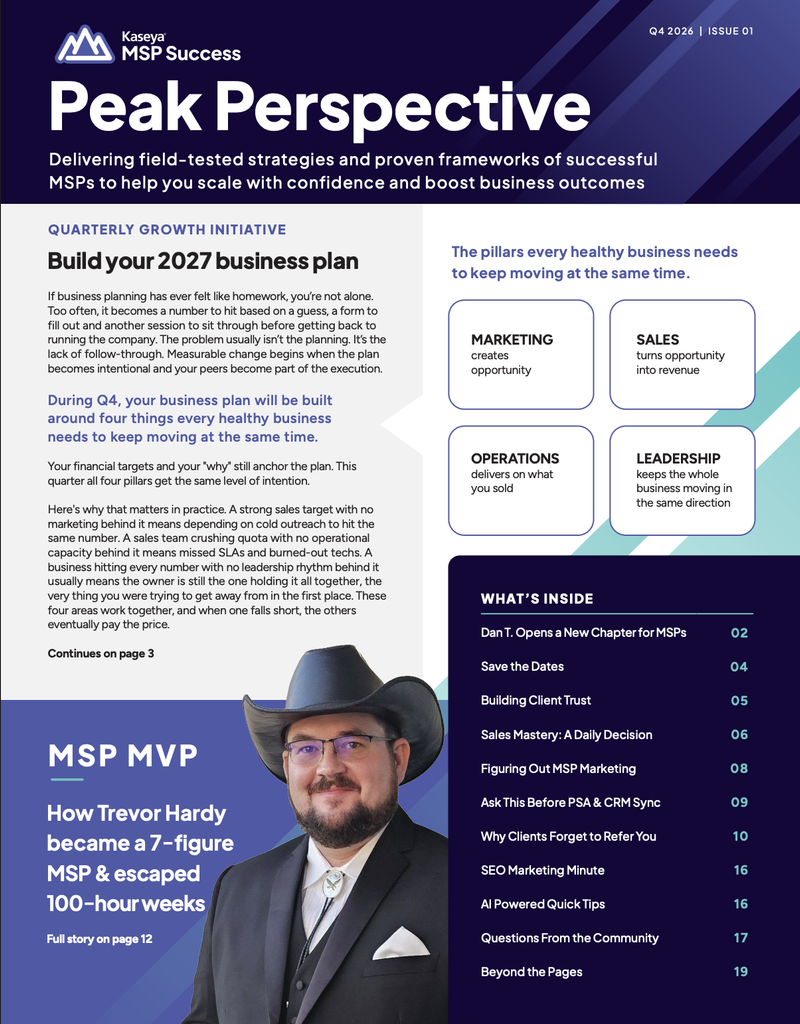
There’s a new resource for MSP Success Digital and Peer subscribers.
Peak Perspective is a quarterly newsletter featuring practical ideas and insights from MSP owners, industry leaders and seasoned professionals. Expect perspectives on marketing, sales and operations, emerging trends, MSP success stories, Peer community insights and upcoming programs and events.
The first issue is available in both print and digital formats.
Why hasn’t AI transformed most MSPs yet?
AI may be dominating the conversation, but for many MSPs, it hasn’t fundamentally changed the way they operate—yet.
In his latest MSP Executive Insights article, Gary Pica digs into the gap between AI’s promise and its impact on MSP businesses today.
Read: Why AI has yet to transform most MSPs
Product Pulse: Turn marketing activity into a growth engine
A great campaign can get someone’s attention. What happens next is what turns that interest into revenue.
In our latest Product Pulse, Danny Hawman, VP of MSP Success Digital, shares how MSPs can connect their CRM, website, automation and follow-up to create a more consistent growth engine and reveals some of the platform capabilities partners may be overlooking.
One quick win? Put your marketable contacts into an evergreen educational campaign so you’re consistently building authority and staying top of mind.
Read the Product Pulse with Danny Hawman
And our September member intro winner is…
Congratulations to Jim Sabino, IT Service Desk Team Lead at Absolute Computer Solutions in St. Louis!
New to the Kaseya Community? Introduce yourself in the Member Introductions forum, start connecting with fellow MSPs and you could be our next monthly winner.
Happening now: Kaseya Community Quest
Ready for a challenge?
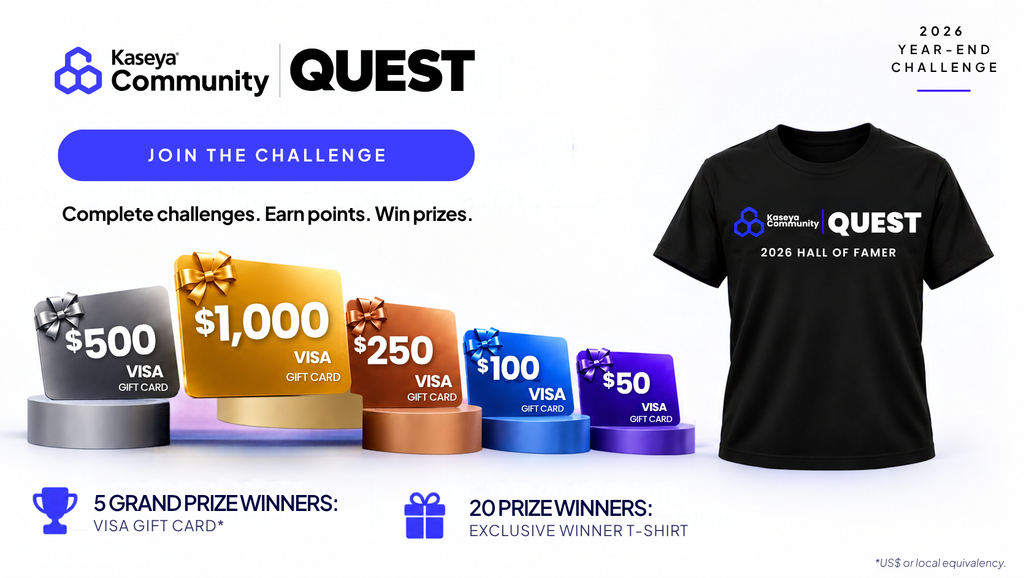
The Kaseya Community Quest: 2026 Year-End Challenge is officially underway, with new opportunities to earn points and win prizes dropping throughout the quarter.
Each week brings a new challenge, including discussions, polls and hidden surprises around the Community. Complete challenges to earn points, climb the leaderboard and increase your chances of winning. Every point you earn also counts as an entry into the grand prize drawing.
With five Visa gift card grand prizes ranging from $50 to $1,000 and 20 exclusive Kaseya Community Quest T-shirts up for grabs, there are plenty of reasons to join the Quest.
Join the Kaseya Community Quest
See you in the Community
Whether you’re catching up on the latest product innovations, learning from MSP leaders, sharing your expertise or taking on the next Community Quest, there’s always something new to discover.