
Dear MSP,
Put away your PowerPoint that walks me through your 5-star reviews and highlights all your shiny tools. Don’t hand me a price sheet. Keep your geek-speak to yourself.
I need to know if you’ll respond quickly if my organization has a problem. If my internet is down, my wi-fi doesn’t work reliably, or I can’t access email, my livelihood and my clients’ needs—and in some cases, their lives—are at stake. It’s just that simple.
So tell me this. Do you fix problems the first time, so they don’t recur over and over, costing me time and money? Do you understand how my business runs and the line-of-business applications I rely on? Can you protect my infrastructure and my customers’ sensitive data? Can I talk to a live person? Do you have boots on the ground if I need you?
These are the qualities I’m looking for in an IT service provider. Your website, your sales process, your marketing all have to convey that you can deliver what I’m looking for. And then your actions have to back that up.
Sincerely, Your MSP Customer
Is There an MSP-Customer Disconnect?
Does that letter from your hypothetical customer surprise you? It shouldn’t. This persona is based on survey responses from nearly 500 organizations across a wide swath of industries being served by MSPs.
The National IT Service Provider Survey, conducted by MSP Success, reveals that what MSP customers want and what you think they want may be drastically different.
“We, as entrepreneurs, always have to remember we are not our customer,” says Robin Robins, CEO of MSP Success and sales and marketing company TMT. “Everybody gets over their skis and they think they’ve got to be talking about cloud and CMMC and cybersecurity. That’s all important. But what people really still care about is when I call your office, do you respond? Are you professional? Do you talk to me about my business versus just quoting me prices?”
Your Customers’ Priorities
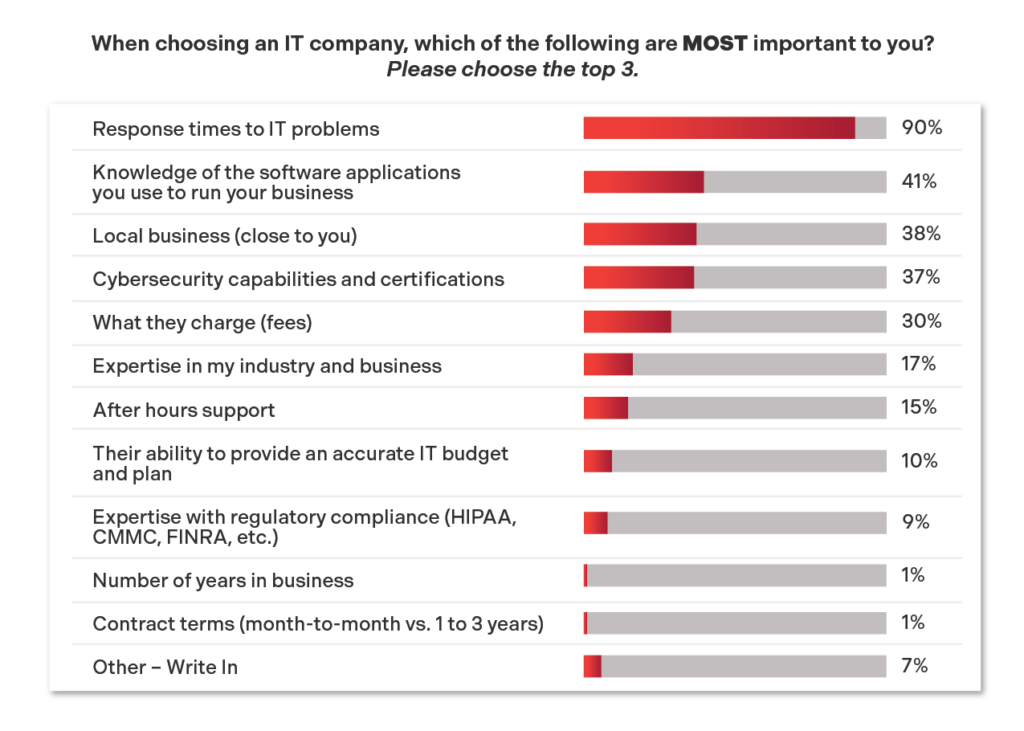
The survey asked business decision makers to name the three most important qualities they look for when choosing an IT company.
Overwhelmingly, and well above other qualities, was response time, with 90% of respondents citing it as No. 1. The next most important criteria were knowledge of the software applications they use to run their business (41%), a local presence (38%), cybersecurity certifications and capabilities (37%), and price (30%).
The importance of response time doesn’t’ surprise Mike Farlow, CEO of ComTech, an MSP based in Graham, North Carolina. “That’s the No. 1 thing we hear when we’re in the field doing sales, and we harp on that as being one of our primary features.”
For survey respondent David Whoie, response time is critical. Whoie is the resident care coordinator at Hunter Hill, an assisted living facility with four locations in North Carolina. The electronic medical record (EMR) system they use to relay information between pharmacies and other providers contains sensitive information about residents. “Obviously we store a lot of files on clouds, so security is very important to us,” he says.
However, when the internet is down, “it’s fairly crippling.”
He explains, “We communicate with families, with providers, with other vendors, with each other, through email. And when we can’t access that, we can’t access our files, or we need a certain policy pulled up and we can’t get to it, it’s a problem that we need solved quickly.”

Whoie turned to ComTech after repeated appeals to their long-time MSP about service issues fell on deaf ears and a visit to another facility where even the phone system was working better than theirs. Turns out ComTech was that other facility’s IT provider.
Still, Whoie vetted several MSPs. ComTech’s knowledge and professionalism won them over. “ComTech went into depth a long time before we started talking about money or what things cost.” Whoie says ComTech first asked what they could do for them, and then explained their services.
Another ComTech client, Fisher Wealth Management, says cybersecurity is a priority. “As a growing, responsible firm, we cannot afford to be out of compliance or experience a cyberattack,” says Rick Fisher, managing partner of the financial advisory firm. “The demand for our services is growing and our clients expect us to keep their financial data safe, so we take it very seriously.”
For Wurster Construction, uptime, response time, and price are important, but having an MSP with boots on the ground is key. Wurster is a $60-$70 million business in Indianapolis, Indiana, and has an on-prem server. Their MSP, AVC Technology, fits the bill for them. “If we’ve got an issue they can send somebody to the office to take care of it and not try and do a bunch of things remotely if they need to be on prem to really see what’s going on,” says the company’s president, Al Wurster.
If They Trust You, These Things Matter Less
What didn’t surface as priorities in the survey were contract terms and longevity in business (both under 2%), expertise in compliance regulations such as HIPAA, CMMC, FINRA, etc. (8%), the ability to provide an accurate IT budget and plan (10%), and after-hours support (15%).
Brian Johnson, CEO of AVC Technology, says multiyear contracts are a bigger stumbling block for prospects than existing customers. “They don’t really know you yet and what level of trust they can give you. You have to prove yourself to them through the sales process.” Once they become a client, he adds, “I don’t think they typically care—if they’re happy.”
Robins agrees. “When people say, ‘No one will sign a three-year contract,’ bull. If you establish trust with customers, she adds, your years in business and your contract terms aren’t primary concerns.
And surprisingly, although respondents say price is important, it’s not at the very top of their list.

“I think everyone is concerned about price, but that’s usually never the top issue,” Johnson says. “If people are honest with themselves, it doesn’t help them to pay for something that doesn’t serve their needs. So if they’re paying the cheapest person and they don’t get what they want, that’s not helpful.”
Farlow echoes that. “We don’t run into the price discussion very much. The only time that it typically comes up is when you are working with a really, really small company that maybe has a really tight budget or they just do not get the whole IT world and the MSP delivery system.”
Your Customers’ Pet Peeves
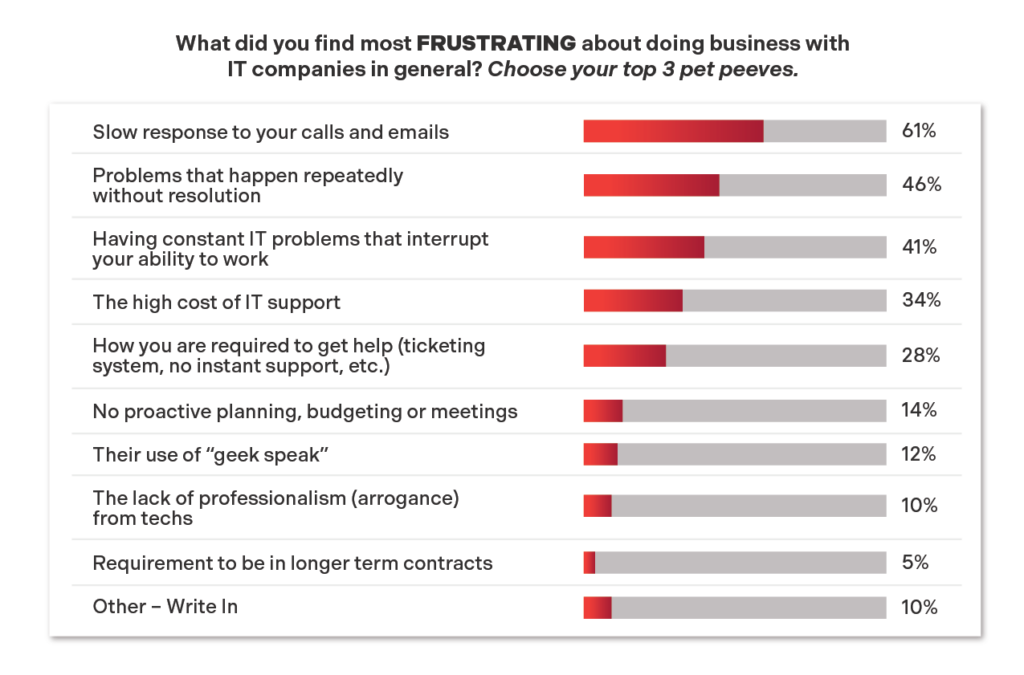
It should come as no surprise that your customers’ top frustrations mirror their top priorities. At the top of the pet peeve list is slow response to calls and emails (61%), repetitive problems (46%), and constant IT problems that interrupt the ability to work (41%). Respondents also cite the high cost of IT support (34%) and how they are required to get help, such as via a ticketing system instead of instant support (28%).
Repeat problems were a pain point for Whoie with their previous provider. “We need things repaired so that the same problem doesn’t happen twice,” he says.
ComTech has processes in place to ensure that doesn’t happen. Techs are trainied to focus on long-term solutions, not short-term fixes, Farlow says. Issues and resolutions are documented in IT Glue, “and also we’ve got it flagged in ConnectWise to let us know when there are recurring tickets.” A service manager reviews reopened tickets to determine if the tech followed the right steps or if there is a bigger underlying issue.
As for MSP customers’ annoyance with submitting tickets, less mature businesses might not understand the need for processes and ticketing systems. Both Farlow and Johnson agree that setting expectations is key.
Farlow says they train clients during onboarding to submit tickets via email or the online portal. “They can call in, but most of the time they’re going to get a voicemail that does the exact same thing. It goes into the ticket system.”
ComTech does offer an emergency 24/7 hotline, but there is a charge associated with that service. However, just by knowing that’s an option “the client seems to be perfectly happy with that.”
Johnson talks with prospect during the sales cycle about the ticketing process and the value it provides. “At the same time, we stress that they can call us anytime. We do live answer the phones on the support side.”
Lisa Johnson, co-CEO at AVC, adds, “I think it’s important to train your team to speak [your customers’] language. Do they like to do a ticket? Or do they like a phone call? Do they like using our portal? That’s different for each customer. You also have to educate the customers that a phone call might not be the fastest way, and let them decide how they want to do it.”
Reflect MSP Customers’ Desires in Your Marketing
Robins says most MSPs instinctively know what’s important to customers, but they need to reflect that in their marketing, website, and sales process.
“What we took from this survey was actually looking at those top three frustrations and saying, ‘Are we marketing to this?’” says Lisa Johnson. They’ve marketed around their live support and response times, she says, and are now using AI to “give me messages that I can use to speak to these frustrations better.”
Farlow, too, is using the data for marketing messages. “We try to make that first and foremost. What are the main pain points that prospects are running into? What are the keywords they’re searching for to find us, and trying to put that up front above the fold [of the website] as much as we can so we retain that attention and hopefully encourage them to read on further and fill out a contact form. Or pick up the phone and give us a call.”
Deliver What’s Important
Robins says she hopes the survey findings will help reset MSPs’ thinking. “Are we spending $100,000 on certification while completely overlooking that we’re not responding to our customers as fast as we could? Go back and ask yourself: Are we delivering on the things that they say are most important?”
Brian Johnson believes what’s important to MSP customers has not changed, even though technology has gotten more sophisticated. “Basically they want somebody they can talk to, responds quickly, and can solve their questions and problems. I feel like that’s always been what our customer base wants.”
If you missed our last reader survey, see The Compliance Gold Rush: How MSPs Are Turning Regulation Into Revenue