
“Everybody’s for sale. If somebody wrote you a big enough check, everybody would sell.”
That’s the reality for today’s MSP business owners, says Jay McBain, chief analyst at technology market analyst firm Canalys. He says M&A is now part of every discussion—at industry events, in hallway conversations, in chats with peers.
MSP Success recently asked readers about their own plans for their businesses—why they would or wouldn’t sell, how they are preparing, what types of deals they would favor, and how they’d spend their days after a sale. See if your MSP exit strategies line up with our findings.
A Split Decision
Inflation, higher interest rates, tech layoffs, and pending elections around the world tamped down the M&A activity about 10-20%, but certainly didn’t extinguish it, says McBain. In fact, he expects about 20% growth next year after the U.S. election is settled.
“Most MSPs are getting phone calls every day,” he says. “It’s a very vibrant market.”
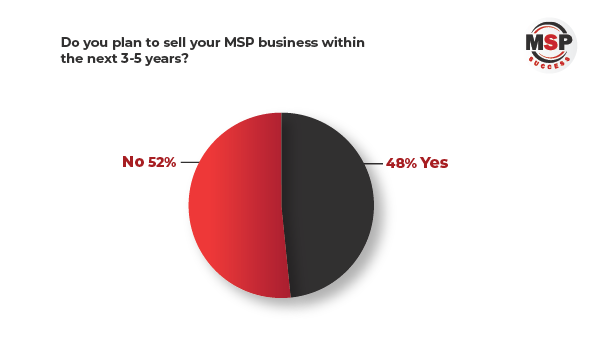
MSP Success’ latest reader survey finds that MSP business owners are almost evenly split on if they’ll sell their companies in the next 3-5 years. Among respondents, 48% say they plan to sell their business in that time period and 52% do not.
We asked owners who do plan to sell what might make the change their minds. The most common response was a poor valuation/offer. On the flip side, owners who don’t plan to sell say an offer significantly higher than their current valuation—in cash—could persuade them.
McBain says that’s in line with what Canalys finds: “71% would entertain a ridiculous check being written.”
Why They’re Not Hanging Out The For Sale Sign
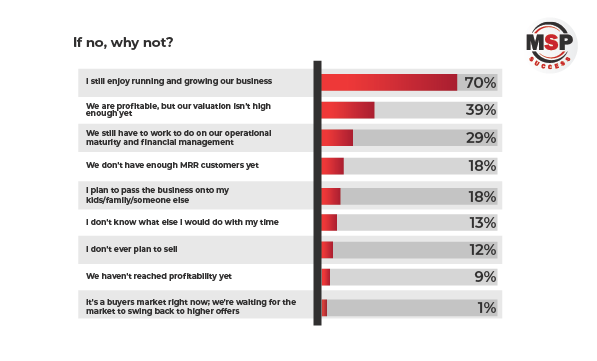
For those owners who have no plans to sell currently, the top reason sited (respondents could choose multiple responses) is they still enjoy running and growing the business (70%). Other reasons include: the company is profitable but the valuation isn’t high enough yet (39%), there is still work to do on operational maturity and financial management (29%), they don’t have enough MRR customers yet (18%), and they plan to pass the business on to family/someone else (18%). Only 1% say they are waiting for the market to change back to a seller’s market.
There’s another reason too, according to Frank DeBenedetto, head of Kaseya’s M&A Concierge program. Among MSPs he’s worked with, “60% are saying they’re looking to buy.”
Matt Rose, co-founder and chief experience officer of Tech Rage IT, an MSP in Orlando, Fla., says he’s not at the right point in life to sell. “I don’t think we’d be at the point where we’d make enough money to sell and be able to really do what I want. But with that said, I wouldn’t want to sell and necessarily go be an employee.”
Why The Time to Get Ready Is Now
Even if you do want to sell, that may not happen if you’re not a best-in-class business, says Paul Cissel, who’s founded and successfully sold three businesses and now advises MSPs on M&A. He’s also the M&A expert in residence for TMT.
“Only 30% of the businesses that go on the market actually sell,” Cissel says.
RELATED: 7 Reasons Why M&A Deals Fall Apart
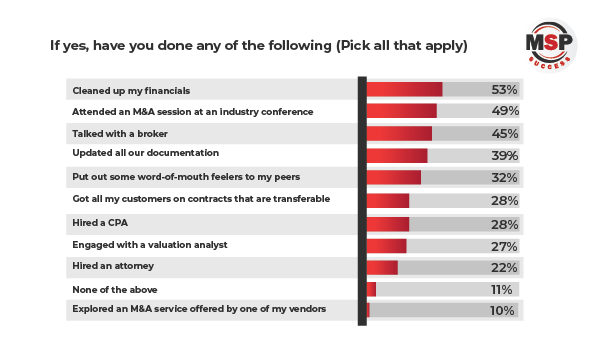
MSP Success asked respondents who do plan to sell in 3-5 years about the steps they are taking to get their businesses market-ready. The top actions included: cleaning up financials (53%), attending an M&A session at an industry conference (49%), talking with a broker (45%), updating documentation (39%), putting out world-of-mouth feelers to peers (32%), and getting customers on contracts that are transferable (28%).
In Cissel’s experience, accomplishing some of these steps is a two- to four-year process. He recommends focusing on some key performance indicators to drive up value and deliver these best-in-class numbers:
- Adjusted EBITDA over 15% (ideally over 20%)
- Service gross margins over 50%
- Total blended gross margins over 42%
- Product gross margins over 30%
- MRR over 50% (ideally over 60%)
“You need to really understand value and how businesses in this industry are valued and what makes your business attractive to somebody else,” Cissel says.
Steps To Boost Value
He recommends meeting with all existing clients to sell them your “latest and greatest.” When you do that, update your MSA to be transferable too.
DeBenedetto says driving down the cost of goods sold (COGS), especially the software stack, is another way to boost value. That’s an exercise MSPs can go through with Kaseya’s ProfitFuel program. “Every dollar we can save you is a direct dollar to the bottom line,” he says. “For most of these MSPs, they’ve never gone through the exercise. They’re so hyperfocused on sales and people are taught to keep selling—grow your top line and the bottom line will follow.”
Going through a COGS exercise, however, “motivates them pretty quickly, especially if they can bump up their EBITDA right away.”
He also recommends building what he calls a “data room” with all the documentation you’ll need when you sign a letter of intent (LOI). “Now is a great time to start doing it because you can take your time, find all the other documents that you might be missing. So when it actually comes time—whether it’s one or five years down the line—you’ve got all that stuff in one place ready to go.”
Jack Fumagalli, head of M&A at Lyra Technology Group, a platform company of Evergreen, a PE firm, says MSPs getting ready to sell should also start investing in talent, such as a sale leader and a marketing person. “Those are the kind of investments that we see a year or two before leading towards an investment process—building out the full team to support the next phase of growth with whatever partner they choose to engage with.”
Show Me The Money
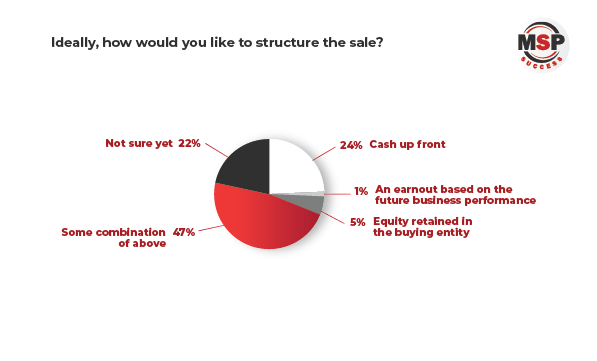
MSP Success asked readers who plan to sell their business how they would like to structure the deal. Almost a quarter (24%) want cash up front, 5% want equity retained in the buying entity, and 1% want an earnout based on the future business performance. Meanwhile, 47% say they would like a combination of those options, and 22% are not sure yet.
Cash up front is what most of the MSPs DeBenedetto has worked with choose. But no matter the structure, he says, the most important thing is that “the potential seller puts thought into what they’re looking to do, because the structure of the deal is almost as important, if not more important, than the amount of money that you would get.”
“Our priority is solving for a structure that meets the needs and desires of the business owner that we’re partnering with,” says Fumagalli. “So we definitely have a mix of those options and are generally flexible to that, whether it’s cash only, whether it’s cache and equity, whether it’s a mix of cache, equity, and earnout.”
Cissel favors cash up front, but acknowledges that “it all depends upon the position in life that they’re in.”
Second Bite Of The Apple?
As for equity in the acquiring company or an earnout, “a lot’s been talked about a second bite of the apple,” Cissel says. With equity, “one of the benefits of that is that you’re not paying capital gains taxes on that right away.” However, he likens it to making a large investment in just one stock and cautions sellers to do their due diligence.
“Most of the people who were reinvesting in [the acquiring company] aren’t doing the due diligence that they would do normally … They’re not even asking for financials, which they should. And they should really understand what the overall track record is of that company on paying back on that second bite of the apple.”
Sellers and buyers typically choose earnouts for two reasons, he says. One is if the seller has a lot of deals in the pipeline; the buyer will structure the deal so that they both benefit from closing those deals. The other reason is if the buyer is not convinced of the stickiness of the seller’s clients. If they stay with the new company the seller gets an earnout on that.
In addition, Fumagalli adds, if a seller wants to take an investment or sell now but the valuation isn’t what they had hoped, “an earnout could be a great way to kind of bridge that time gap.”
What Will You Do With the Rest of Your Life?
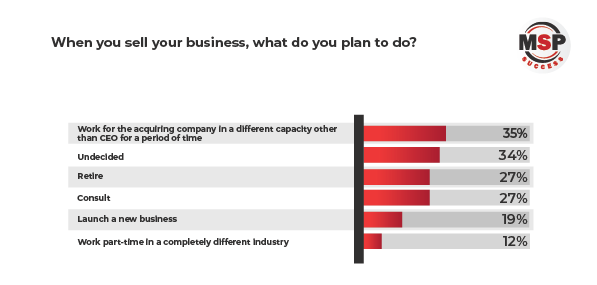
MSP Success asked readers what they plan to do after selling their business (multiple answers were allowed). The top answer (35%) is to work for the acquiring company in a different capacity other than CEO for a period of time, while 27% plan to retire and another 27% plan to consult. Slightly more than a third (34%) are undecided. Nineteen percent plan to launch another business and 12% say they will work part-time in a different industry.
DeBenedetto says most of the MSPs he’s been working with have been in business 20-plus years but do not want to retire just yet.
“They’re looking for a little bit of change or they’re looking for less responsibility,” he says. “They still enjoy the industry; they just don’t want all the pressure and stress of being the owner.”
Fumagallli notes that “going through an M&A process is probably one of the biggest decisions a business owner can make.” It’s not always a linear path, and there can be ups and downs, he says. Being undecided about what’s next is “somewhat common when we talk to someone about why they’re moving towards the next phase. It’s usually not a crystal-clear answer.”
But Really, How Much Golf Can You Play?
Cissel encourages all MSP business owners to think through not only how they’ll spend their money from the sale, but how they’ll spend their time. “A lot of people will think that you’re going to play golf every day, but that gets kind of boring.”
In addition to a wealth manager, a good attorney, and a tax consultant, Cissel advises, “Spend a lot of time with your spouse or partner on what you’re going to do.”
You want to be ready when the call comes, because as McBain notes, buyers’ interest remains high. Rose, who’s taken his share of calls, affirms that. “I think they’ve lessened in the last six months or so, and that’s probably just the economy and the cost of loaning money out right now, but it’s definitely pretty often. I’m sure if we did want to sell it today, tomorrow, I could get plenty of companies to give me an offer pretty quickly.”