Artificial intelligence isn’t just another tool in the MSP toolkit. It’s a tsunami reshaping how services are delivered, operations are streamlined, and new revenue streams are created. The question every MSP must answer is simple: Will you ride this giant wave, or risk being left behind?
“It’s been fairly easy for MSPs to be a catch-all, everything from VAR to break-fix to security to compliance,” says Trish Cody, co-founder and co-owner, 12 Points Technologies, an MSP in Omaha, Nebraska. “But I think that as we continue to add all these things, and AI is accelerating that, it’s going to become harder to be the one-stop shop for everything. I think we might start to see more specialization.”

The stakes couldn’t be higher. “I think that there’s a fundamental shift that’s happening right now,” says Christopher Sumner, partner at Univision Computers, an MSP headquartered in Missoula, Montana. “There’s also some risk, [with] a lot of competing [AI] models. It reminds me of the VHS and Betamax story: Which model is going to work?”
Which business model will carry MSPs into the future is in flux too. “Most MSPs, 99.9% of them, are not going to be doing model development,” predicts Sumner. “They’re going to be leveraging models. There’s going to be a cursory understanding of how to put guardrails on those models. But that’s completely trainable, coachable, and somebody can come to speed really quickly.”

What’s clear is that the AI lens is coming into focus for the industry. Some MSPs are already carving out new opportunities while others are struggling to define their path forward. To find out where the divide is forming, we asked MSPs how they’re using AI inside their businesses today—and where they’re seeing the biggest opportunities and challenges ahead. Here’s what they had to say in our latest MSP Success Reader Survey.
Test Driving and Buying AI Tools
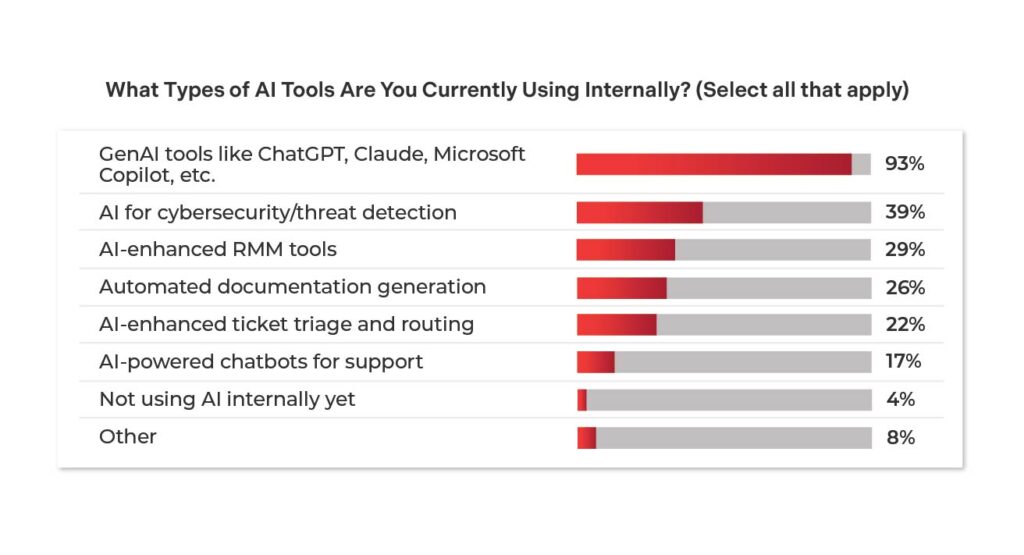
While artificial intelligence, automation, and machine learning are not new, generative AI burst into the mainstream in late 2022 when OpenAI launched ChatGPT. Today, nearly all (93%) of MSP Success Reader Survey respondents say they’re using GenAI tools like ChatGPT, Claude, Microsoft Copilot, etc., internally. Other internal uses include cybersecurity/threat detection, AI-enhanced RMM tools, automated documentation generation, AI-enhanced ticket triage and routing, and AI-powered chatbots for support. Just 4% of respondents are not using any AI internally.
MSPs overwhelmingly (82%) say AI is providing the biggest benefits in the sales and marketing area. Other departments or functions reaping rewards from AI use include executive leadership/business development (59%), help desk/support (53%), and security operations (33%).
Chris Gotstein, president and founder, GoTech IT Solutions, an MSP in Brookfield, Wisconsin, says tech and operations are using Copilot, but sales and marketing are the biggest beneficiaries so far. His team is using ChatGPT and Claude, as well as HeyGen, an AI video generator and they are creating content “much quicker than in the past,” he says. GoTech has created avatars of their clients, their business, and Gotstein himself that marketing uses to produce content. It’s paying off. “We’re definitely seeing a higher engagement,” Gotstein says.

Sumner says the service department has benefited the most from AI. “It allows for us to be a little more responsive and basically cut down the SLA of our problem to resolution. That’s probably the most impactful. If you ask me in six months, I’ll probably have a different answer because we’re constantly leveraging [AI] and seeing a lot of benefits in a lot of areas.”
Deriving Efficiency Benefits from AI
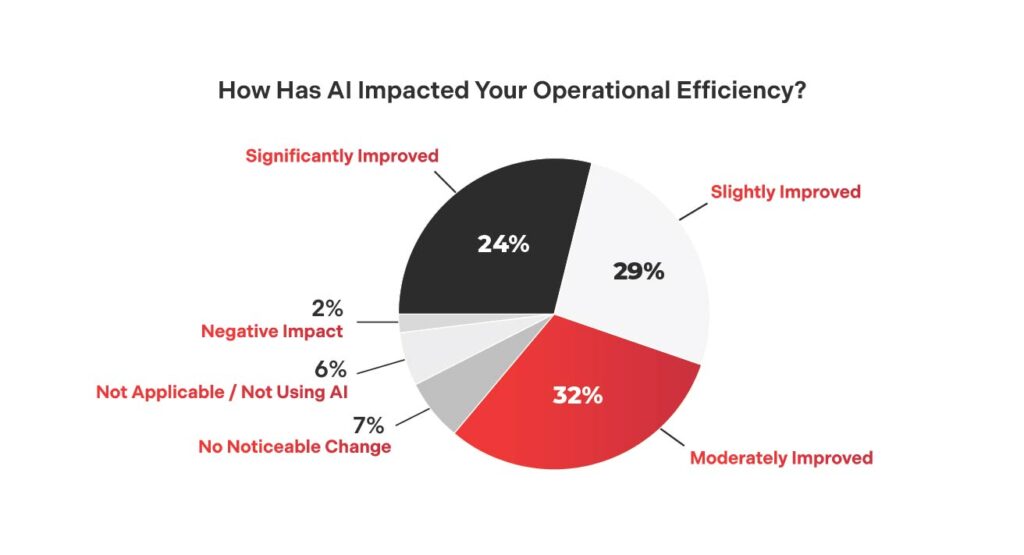
Our reader survey respondents split somewhat evenly on how AI is impacting their operational efficiency, with 24% reporting significant improvement, 29% slightly improved, and 32% with moderate improvement.
For Charles Henson, owner of Nashville Computer in Tennessee, the impact of AI on operations has been significant. “It’s allowing us to do way more with less,” he says. His MSP leverages both Pia, an AI-driven automation platform, and Hatz AI, a secure AI platform with containerized LLMs. They’ve used both to build apps for internal use.
In one use case, they’ve built an app to ingest, audit, and reconcile all vendor invoices. “It audits what we’re selling our clients versus what we’re paying for,” Henson explains. “So two things happen. Number one, we verify that we’re not overpaying for services from all of our vendors. And number two, we verify that we have everything on every site of every client’s desktops and servers that needs to be installed that we’ve sold them.”

He adds, “Our billing is more accurate than it’s ever been. That’s a process that used to take hours every single month. And now it’s just a matter of uploading each invoice and uploading the PSA output and telling it to compare; it tells us what we need to resolve.”
Monetizing AI: The Next MRR Goldmine?
Henson is also reselling Hatz AI to his SMB customers. “It is a private container, so everything that you do inside of Hatz AI using any of [its] 40 LLMS, it is keeping your information safe and secured.”
Sumner is using Hatz AI as well as some other tools, and has recently rolled out a three-tiered offering called the AI Jumpstart Program. The program targets both managed customers and non-managed customers wrestling with how to implement and benefit from AI. Education is just one element of the offering. “The goal … is to work with you, document what you can do, and implement an AI or process enhancement using AI directly in the engagement. … Every single tier [of service] leaves you with AI actually giving you an ROI,” he explains.
Sumner and Henson are not alone in monetizing AI. According to our survey respondents, 39% currently offer AI-related services to clients, with another 32% planning to in the next 12 months.
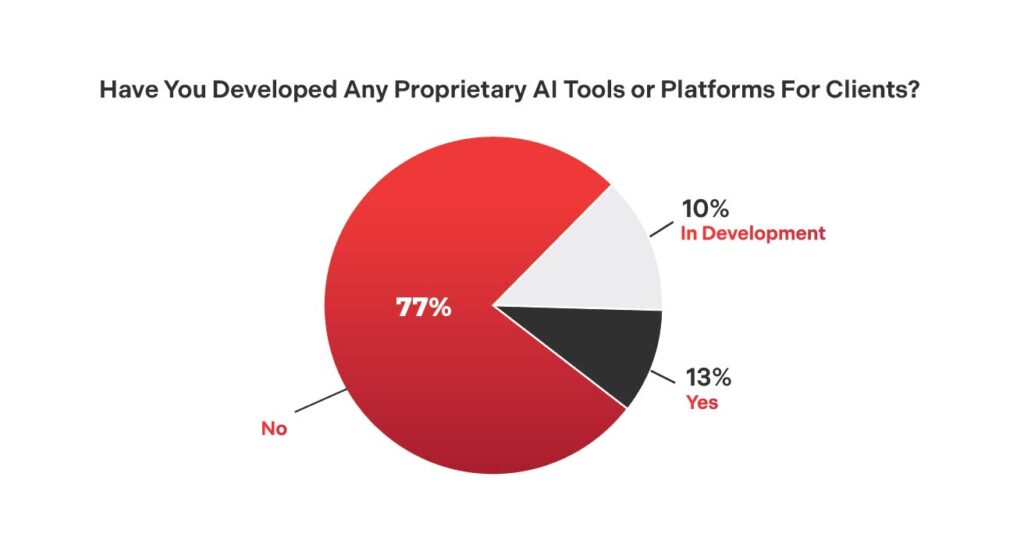
Notably, only 13% of MSP respondents have developed proprietary AI tools or platforms for clients; 10% say they are in development.
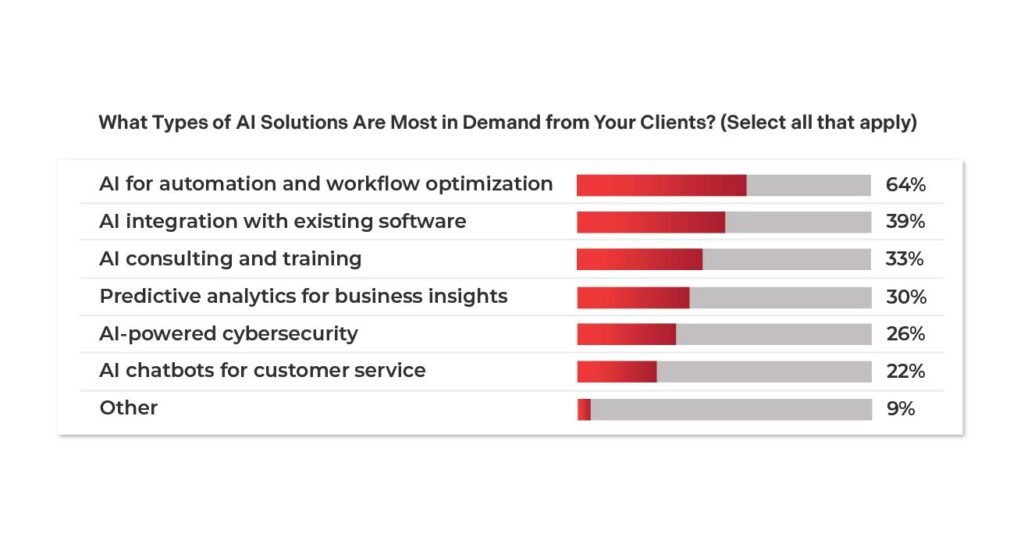
Survey respondents report the top request from clients (64%) is to help them use AI for automation and workflow optimization. Other types of AI solutions in demand include AI integration with existing software (39%), AI consulting and training (33%), predictive analytics for business insights (30%), AI-powered cybersecurity (26%), and AI chatbots for customer service (22%).
Cody says customers have not made many requests for AI solutions, “but we know that it’s only a matter of time. We do get asked about ways to stay safe with AI, use case things with AI, [and] use policies.” She says they have been offering some education and are prepping a workshop.
GoTech has always offered customer training and education “and now AI has fallen into that by default,” Gotstein says. Next year, they plan to package and sell some AI training add-ons. “We’ll have maybe one or two different options for either a block set of hours for AI training or we’ll do three AI projects for that month,” he says.
For survey respondents that do offer AI solutions, 31% have monthly recurring service plans (31%), 30% have project-based pricing (30%), and 18% have custom pricing per client.
Facing the Challenges and Scaling the AI Learning Curve
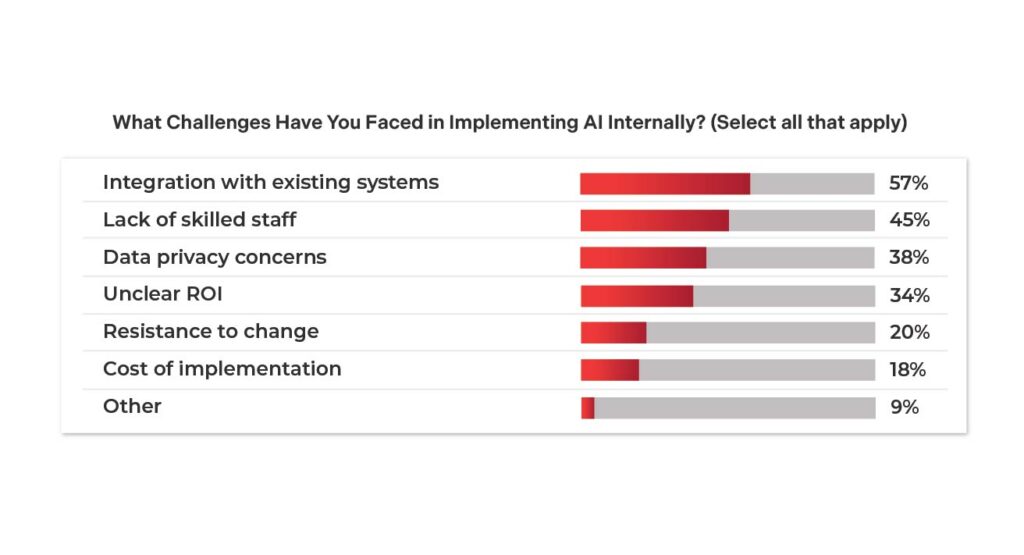
For MSPs implementing AI internally, integration with existing systems is the top challenge, according to 57% of respondents. That’s followed by lack of skilled staff, data privacy concerns, unclear ROI, resistance to change, and cost of implementation.
Sumner thinks challenges like cost and upskilling staff “are easily solved.” For his MSP, the biggest challenge was understanding how they were going to leverage AI as part of the business. “Once that was identified, I think the implementation went quite quickly,” he says.
To address data privacy and security concerns, some MSPs are crafting guidelines and acceptable use policies (AUPs). Sumner, for instance, has an AUP for internal use. Univision is also offering it free to customers in a modifiable template.
GoTech has an AI use policy that “dictates what employees can use in terms of which GPT is made available to them, what information they can and can’t put into it, and basic guidelines on usage,” Gotstein says. The policy also specifies that free versions of tools are not allowed. “It has to be an approved company version that is paid,” he notes.
In terms of skilling up staff, 33% of respondents say they are investing in AI training or certifications for their team, 33% are planning to in the next 12 months, and 34% are not offering education.
Related: AI Certifications for MSPs: Will They Pay Off?
Looking Ahead
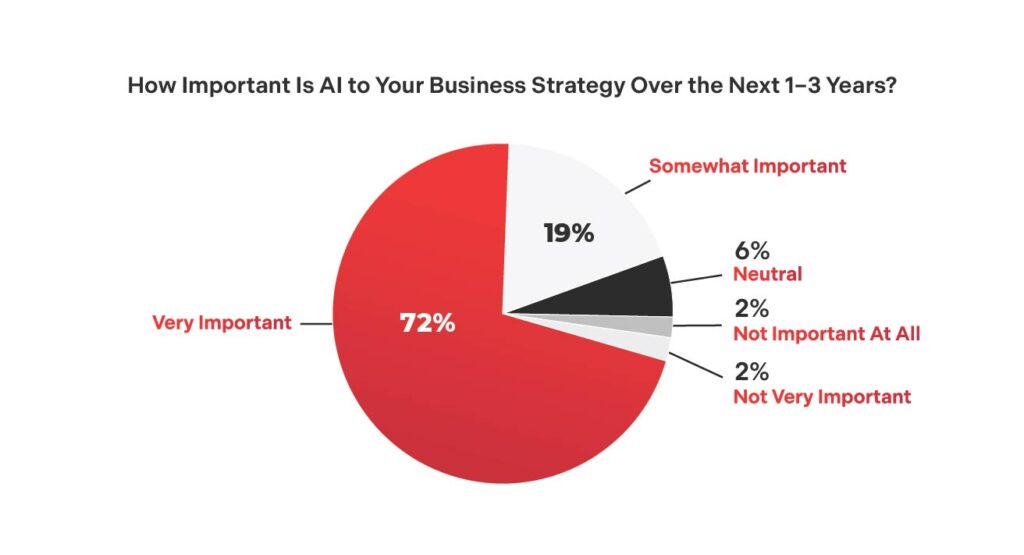
Our reader survey asked respondent how important AI is to their business strategy over the next 1–3 years. The majority (72%) say it is very important and 19% call it somewhat important. Only 4% say it’s either not very important or not important at all.
At the same time, respondents note that the increased use of AI in the MSP space does raise some concerns. These include security, compliance, and the erosion of customer relationships. In addition, some fear that they won’t be able to keep up with MSPs that have the budget and skills to implement AI faster.
“The only concerns I have is people using it insecurely,” Henson says, by using free versions of tools or even using paid versions but without governance policies in place. “The potential of danger in our MSP community is we’ll have MSPs that are putting contracts up there or other information about clients that they shouldn’t be. And maybe it’s just because their lack of knowledge or maybe they’re doing it by mistake.”
Cody adds that customer expectations are changing too. “MSPs, I feel, have this choice they have to make [about] where on that spectrum they’re going to land,” she says, whether they’re going to step outside traditional managed services and move toward building customer automations and workflows, or adopting a hybrid model using AI to augment current services.
That’s an ongoing discussion at 12 Point Technologies, she says. “It’s figuring out what that sweet spot is, and what makes sense for our local market as well. And then do we have the right people on staff for that? Do we need to change staffing or get people training? It’s a big question.”
For Henson, it’s full speed ahead. “This is the next cloud. This is the next big cybersecurity thing. It’s the next thing inside our industry and if you’re not adopting now, then you’re already behind.”