
Can you ever have too much of a good thing? When it comes to profitable clients, the answer is a resounding “hell, no!” Our latest MSP Success reader survey on the most profitable managed services customers finds that 87% of MSPs are actively targeting more clients in their most profitable sectors.
But what characteristics make one client more profitable than another? What services do they value? Does size matter? How do you find—and keep—those high-value clients? And do they come with their own unique set of challenges?
We asked our readers to weigh in on these questions and share strategies for growing a more profitable client base. And while MSPs say seat size, vertical industry, and higher-end services all play a part, there are some intrinsic qualities savvy MSPs are homing in on too.
Do Size and Industry Matter?
For more than half (65%) of MSP survey respondents, the typical size of their most profitable managed services clients is 11-50 employees. For another 27% of respondents, 51-200 employees is the sweet spot.
The most profitable industry vertical is manufacturing (51%), followed by healthcare (34%), accounting/CPA (33%), architecture, construction, engineering, or ACE (30%), finance (30%) and legal (30%).

For Ted Shafran, real estate and property management firms with 25-50 employees are his best customers, but “we have three or four who are considerably bigger and they are generally more profitable,” says the president of Ontario, Canada-based Connectability.
Shane Naugher, president of DaZZee I.T. Services in Branson, Missouri, says local city governments and municipalities with 25-75 employees tend to be his most profitable clients. He has this caveat, however. “They have to be forward thinking, looking at how do they leverage technology to drive better efficiencies, better results, and serve their constituency better,” he explains. “That makes a much more profitable engagement than it does if you’re constantly struggling to get them to see the value of technology.”
Construction and engineering are the most profitable clients for Houston, Texas-based Preactive IT Solutions, which serves businesses typically in the 50-150 user range, says founder and CEO Charles Swihart. Their construction and engineering clients tend to be on the higher end of that range, he says, and “know enough about cybersecurity to be scared and really value what we do.”
Loyal and Lucrative

On average, profitable clients tend to be loyal, with 56% of respondents retaining them for 3-10 years, and 40% boasting retention of 10+ years.
“I don’t have a lot who leave,” says David Stinner of his most profitable clients. “One of my best has been with us 21 years,” add the president and founder of USitek, in Tonawanda, New York. Those clients are typically manufacturing and logistics firms with 30 users.
“If they look at IT as an investment, typically that’s going to be a long-term relationship,” says Naugher.
When it comes to average gross margin for their most profitable clients, 43% of survey respondents report 50-70% with another 36% getting 20-50%. Just 13% see an average gross margin above 70%, and only 8% report 10-20%.
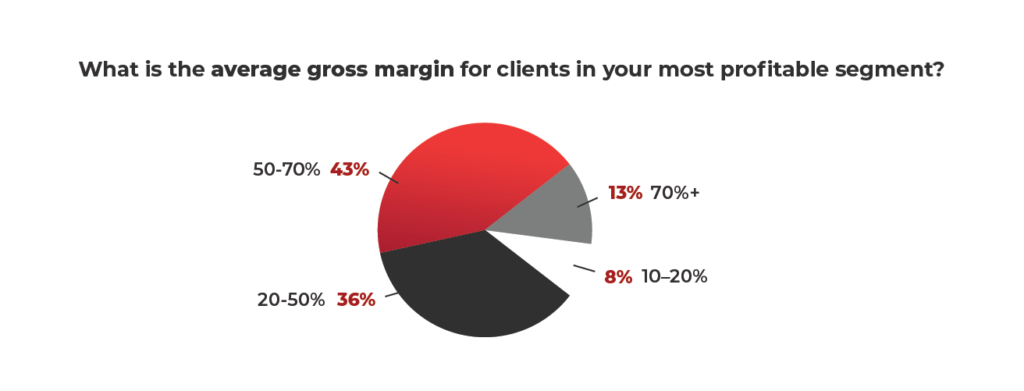
Stinner set a goal of 70% average gross margin a few years ago, “and we were working towards that and turning all the dials in the business to get us there,” he explains. Today, he’s at 71%.
Across his client base, Naugher averages 50-70%, but his top-tier clients are around 70%.
What percentage of an MSP’s annual recurring revenue (ARR) do the most profitable clients represent? For 39% of respondents, it’s 30-50%; for another 31% it’s 50% or more.
Ther most profitable services are cybersecurity and managed security services, according to 73% of respondents. Those are followed by helpdesk support (48%), backup and disaster recovery (46%), network monitoring (28%), cloud services (24%), SaaS backup and management (20%), and co-managed IT (18%).
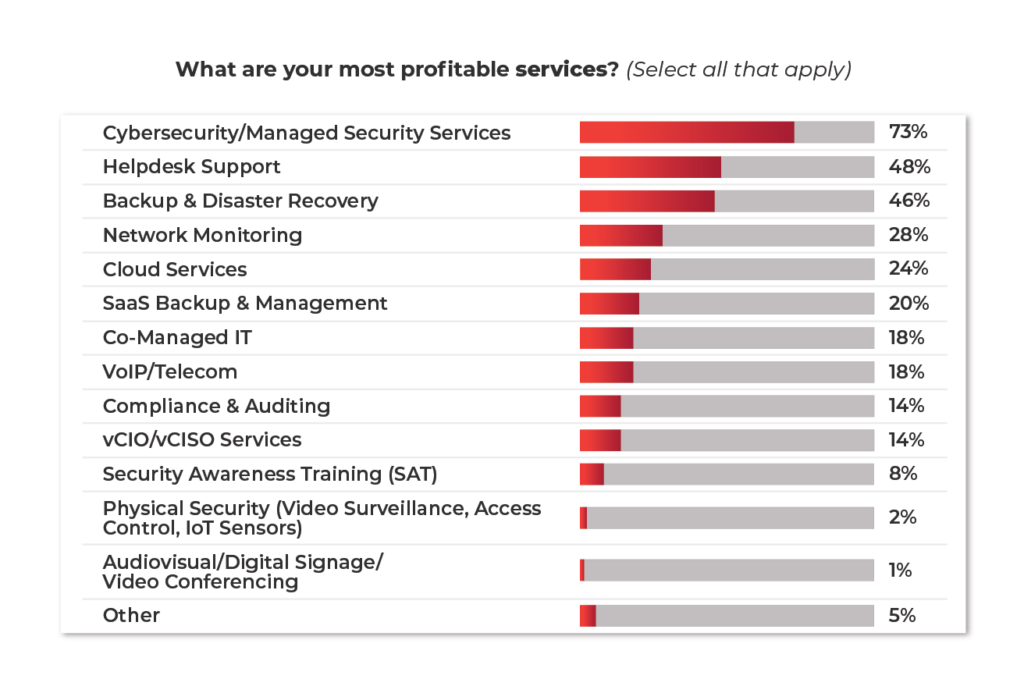
For Shafran, business continuity and disaster recovery (BCDR) is a key profitable offering along with security tools.

Swihart echoes Shafran about the profitability ofsecurity tools, while Stinner points to compliance as a winner for his company.
Naugher says clients that avail themselves of advanced services along with more consulting and strategic advisement are “more profitable for us, but it’s also more profitable for the client as well because they get more out of that engagement that allows them to grow and scale and do so more securely.”
Characteristics of High-Value Clients
MSPs know that company size or industry are not the only things that make some clients more profitable than others. The top characteristics of high-value customers are higher adoption of all the MSP’s service offerings (72%) and decision makers who understand the strategic importance of technology (71%). Other commonalities are low support needs (42%), the organization is growing (40%), and long-term contracts (34%).
“I have one standout client in particular who, if I could replicate any single client, it’s them,” Swihart says. “They are willing to meet with us and talk about strategy. If we recommend something, eight times out of 10, they’re going to do it. They are not afraid to spend money where money should be spent.”
He continues, “When the client views us as a partner, which requires us to do things in a certain way, then they are easier to work with and they’re going to be more profitable because they’re going to value what you say. They’re going to have less interruption [and] a better experience.”
Stinner agrees. His most profitable clients “don’t see us as just a cost. They have to see us as strategic in the same way they [view] their accounting firm, their legal firm … and they take our advice.”
In addition to taking advice, Shafran says his most profitable clients are “very security conscious.”
On the flip side, Naugher says less profitable clients are “a lot more noisy. They have more issues [and] downtime. They have more risk and liability. But it’s because they’re not looking at IT from a holistic approach.”
Often, he says, these customers are not process driven. ”They’re resistant and don’t want to follow process. They don’t want to have that documentation and that procedural aspect in place.”
If a client is open, though, Naugher says they can become a higher-value customer who not only gets a better return on their technology investment but returns a better margin for DaZZee. However, he says, that can be a several-year journey.
If One Is Good, More Are Better
Swihart, Shafran, Naugher, and Stinner, like the majority of survey respondents, are all actively targeting more clients in their most profitable segments.
Swihart follows EOS principles and has a target client profile of construction and engineering companies in the Houton area with 50 to 150 computers who value cybersecurity. “If we can find 100 of those people, that’s who we want to go after.”
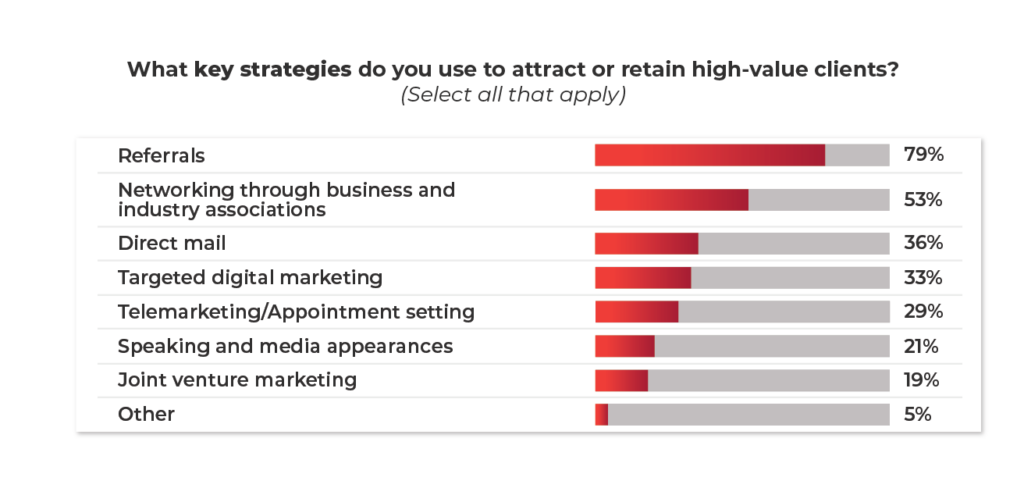
The top strategy MSPs use to attract or retain high-value clients is still referrals, according to 79% of respondents. That’s followed by networking through business and industry associations (53%). Other favored techniques include direct mail, targeted digital marketing, and telemarketing/appointment setting.
For Stinner, who’s focusing on distribution, logistics, and manufacturing businesses, his outreach includes face-to-face networking, some direct mail and e-mail blasts, social media, and hosting events. They participate in local trade shows in those verticals too. His MSP is also an associate member of the Buffalo Niagara Manufacturing Alliance and Stinner writes a column in their newsletter.
Shafran says his MSP has engaged SEO consultants to improve their organic presence online, and uses an outsourced SDR to send out regular mailing and set appointments. He adds, “Obviously, we’re also asking our larger customers for referrals.”
Beware Speed Bumps
Profitable clients do not come without challenges, according to survey respondents. These include resources and bandwidth to support them as they grow, staffing, competition from cheaper competitors, response time, raising prices, showing value, scaling while retaining white glove service levels, time to do QBRs and strategic planning with them, staying relevant, and keeping them secure.

For Swihart’s ACE clients, challenges include serving less technical field workers in rugged conditions and providing mobility connectivity on job sites.
And while referrals among the ACE vertical are great ways to get new customers, it can cut both ways, Swihart says. “They all know each other. If you have a bad experience it might travel through the grapevine.”
Otherwise, though, “it’s a good vertical,” he says.
Stinner says business development is always a challenge. “The sales cycle is really long,” he says. “Sometimes we’re talking to somebody for more than a year before they make a move, but then they make a move and they’re loyal to us practically forever.”
Delivering great service can be a double-edged sword too, says Naugher. “One of the inherent dangers when you do a great job of reducing the noise and issues is they’re not seeing you put out as many fires,” which may lead to questioning if they need an MSP.
To address that, Naugher implemented more strategic consulting, demonstrating that “you’re not having issues because we do proactive auditing and alignment and initiatives to reduce that for you. But what does that look like at the next phase? How do you leverage technology better for growth and efficiency?” The key is keeping them engaged with technology and the goal of leveraging it better, he says.
For Shafran, data volume is a challenge. “Bigger clients tend to have more data, and so that means if we have to do a data recovery or rebuild a server it’s just going to take longer. They expect that for the money they’re paying, they’re going to get rapid response and we do our very best to make sure they get that.”
Weeding the Garden
At least once a year, Shafran analyzes profitability per client. For those on the low end, he either finds them another MSP or gives them an opportunity to move into a fully managed plan.
Stinner tries to be discerning from the get-go, joking that his business development manager complains about that. “We don’t close as many deals as he wants because we won’t write contracts that I know won’t be profitable,” he explains. “I used to do that, and I learned it’s not worth it. You pick up revenue, but you dilute your profitability and you add to the stress of the team.”
In addition, Stinner regularly evaluates and eliminates customers who bring down the culture of his company.
Numbers Don’t Lie – Rely on Them
Tipping the balance in your customer base toward more profitable and enjoyable engagements takes discipline. The turning point for Naugher came from a combination of factors.
“First and foremost is understanding your numbers, understanding the levers that drive your profitability,” he says. “It requires measuring them consistently and being accountable to those numbers. Being part of a peer group that helps hold you accountable is huge, and if you’re not part of one, you should find one.”