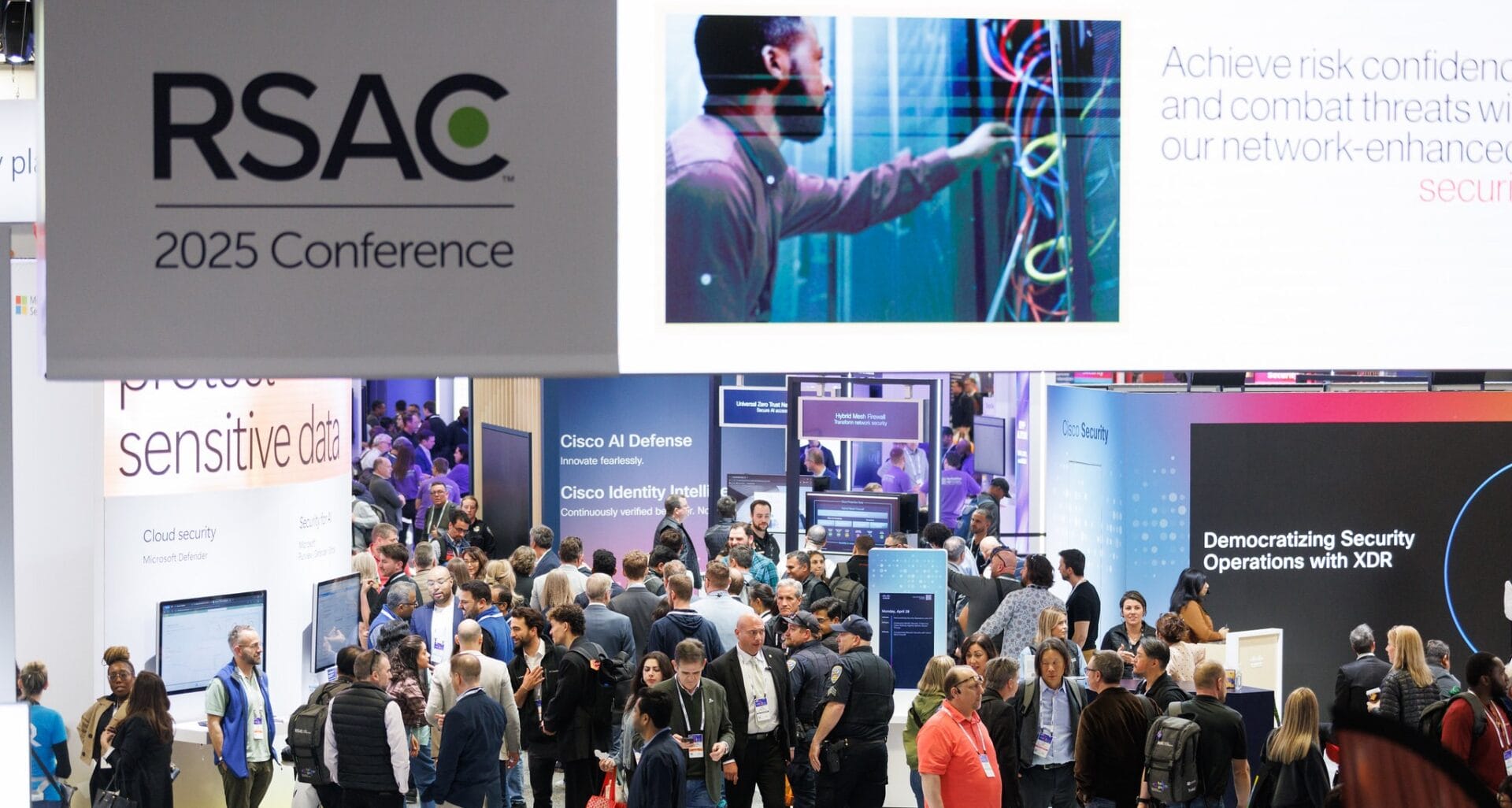
As AI fuels imaginations across the globe, attendees at the annual RSA Conference (RSAC) in San Francisco this week are dealing with the real-world security implications of artificial intelligence. A sense of disquiet over AI use by threat actors was tempered by calls to leverage the technology to fight back. But coordinated, unified approaches are needed, said attendees.
“There’s never been a more important time for us to come together as a community. So much is changing. The way that attackers operate is changing dramatically,” said RSAC Executive Chairman Hugh Thompson. Rapid adoption of AI and the security implications of its pervasive use, he added, are causing “massive changes to what we do.”
Now in its 34th year, the conference drew 44,000 people from 140 countries. Thompson encouraged attendees to share, collaborate, and learn from each other to defend against cyberattackers during a time of great change.
AI: A Double-Edged Sword
While AI discussions typically revolve around benefits, RSAC attendees focused on threats and defenses—specifically how to leverage AI to tackle the very risks it enables.
And those threats are on the rise. Previewing its soon-to-be-published 2025 Cybersecurity Readiness Index, Cisco revealed that 86% of companies worldwide have experienced AI-related security incidents in the past 12 months.
“The cybersecurity threat landscape has never been more dynamic and complex, with adversaries constantly emboldened and enabled by AI to drive new attacks and exploits,” said Jeetu Patel, the company’s executive vice president and chief product officer.
But understaffed IT and cybersecurity teams can leverage AI to fight back, Patel said. Cisco is on a mission to secure and leverage AI with novel open-source models and tools, AI agents, and IoT advancements, along with the Cisco Security Cloud. “These innovations will help level the playing field and deliver AI innovation that makes all businesses more secure,” he said.
Unified Approaches to Cybersecurity
Effective cyber defenses demand simplified, unified security approaches. The proliferation of cybersecurity tools over the years is a constant concern for cybersecurity professionals. Having to manage too many tools complicates an already complex task, which AI-related risks have made even more challenging.
In the spirit of simplification and collaboration, Cisco and ServiceNow said they have “deepened their partnership to help customers adopt and scale AI securely and efficiently.” They’re combining Cisco’s infrastructure and security platforms with ServiceNow’s AI-driven platform and security solutions to help customers decrease risk when scaling AI. The first integration will bring together Cisco’s AI Defense and ServiceNow’s SecOps, the companies said in a joint release.
“By combining Cisco’s advanced AI security with ServiceNow’s role as the AI control tower for the enterprise, we’re helping customers operationalize trust, ensuring that AI is governed, secure, and ready to scale,” said Amit Zavery, president, chief product officer, and COO at ServiceNow.
Blackpoint Cyber also wants to address tool proliferation with its new CompassOne platform. The platform unifies preemptive measures with real-time detection, giving users complete visibility and context across their entire attack surface, the company said.
Battling Back Against Identity Threats
Identity-based cyberattacks were on the minds of RSAC attendees. Huntress released its 2025 Managed ITDR Report, which revealed that two-thirds (67%) of polled organizations reported an increase over the past three years. Additionally, identity-based attacks account for more than 40% of security incidents at 35% of organizations, the report says. Response times are lacking, with more than half of organizations (53%) saying it takes them hours to detect identity-based incidents.
To address identity threats, Huntress enhanced its Managed Identity Threat Detection and Response (ITDR) solution, which the company says has a false positive rate under 5%. “For MSPs juggling dozens of client environments, this is the difference between reactive firefighting and proactive service delivery,” said Prakash Ramamurthy, the company’s president and chief product officer. The offering boosts MSP revenue potential and helps prevent customer churn, he said.
Huntress also introduced a Managed Security Information and Event Management (SIEM) solution to accelerate threat detection and response and simplify compliance. “Historically, SIEM tools were perceived as inaccessible due to high costs and complex implementations. Huntress Managed SIEM delivers a disruptive and cost-effective solution that MSPs can confidently provide to a wider range of clients,” said Huntress CTO Chris Bisnett.
In other identity-related RSAC news, Flashpoint added capabilities to its Ignite platform, including AI-powered risk discovery, curated threat feeds, and asset-centric intelligence. Flashpoint said these capabilities help make informed decisions to protect critical assets. In its 2025 Global Threat Intelligence Report, Flashpoint reports that infostealer malware accounted for 75% of the 3.2 billion compromised credentials last year.
Meanwhile, Netwrix unveiled its Data Security Posture Management (DSPM) solution, which identifies and eliminates data exposures in Microsoft 365 environments. The company also added risk assessment capabilities to its 1Secure SaaS platform, enabling quick scans of Active Directory, Entra ID, and Microsoft365 environments. An AI-assisted remediation workflow guides users through remediation steps and security posture improvements.
And Forcepoint launched Forcepoint Data Security Cloud, an AI-powered, cloud-delivered data security platform uniting visibility and control of data wherever it’s created, stored, or moved. The platform lets organizations gain an understanding of their proprietary and sensitive data, dynamically adapt to risk in real time, and simplify management with automated, behavior-aware protection, the company said.
Channel Initiatives
During RSAC, Malwarebytes highlighted several channel initiatives, including the recently launched Partner Sales & Technical Certification Program and new partnerships with Bakotech, CMS Distribution, Onecom, SuperOps and TeamViewer. The certification program tailors information for partners to drive sales, support the vendor’s ThreatDown cybersecurity solutions, and scale their business.
The company also launched a partnership program that enables finance and HR companies and internet service providers to integrate AI-powered, easy-to-use, personal security, privacy, and identity solutions into their offerings.
With all these new security-focused products and AI initiatives, it’s easy to see that vendors are moving towards a “fight fire with fire” approach to defending against AI-empowered attackers. For more AI-related security news, read about 1Password’s recent stake in agentic AI security ground here.