
If 2025 tested MSP resilience, 2026 looks like a year to cash in on it.
By most measures, 2025 wasn’t an easy year to run an MSP. Inflation lingered, interest rates stayed high, buyers hesitated, and uncertainty—from tariffs to geopolitics—made planning harder than usual. And yet, MSPs delivered. The latest MSP Success Reader Survey shows that revenue and profits rose for a majority of MSPs, and now, heading into 2026, confidence is even higher. Why? They’re increasingly focused on operational discipline and sharpening their niche, margins, and growth strategy.
From revenue and profitability trends to where MSPs see opportunity—and potential risk—in the year ahead, the data paints a clear picture of how MSPs are planning to win in 2026.
A Bullish Outlook for MSP Revenue and Profit
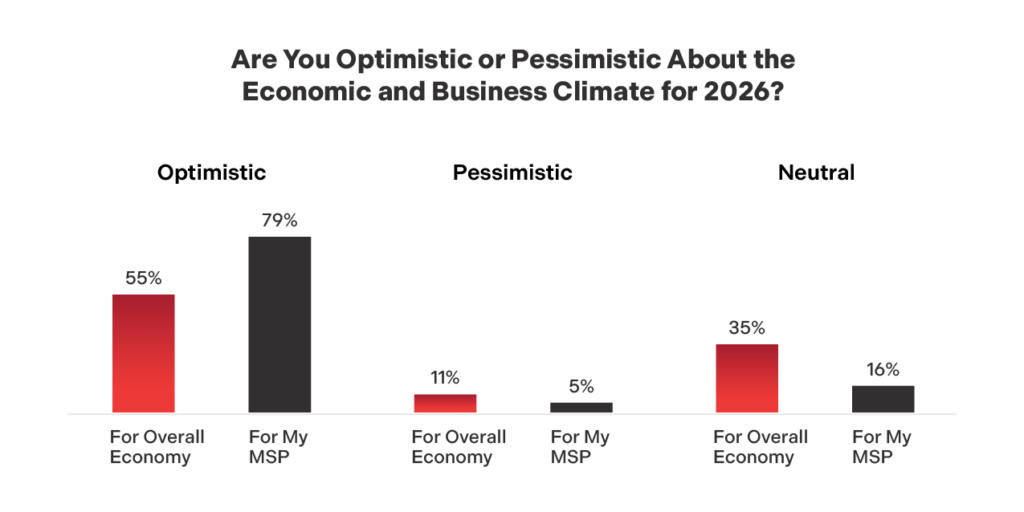
While 55% of MSPs are optimistic about the overall economic outlook and business climate for this year, nearly 80% are optimistic about the outlook for their MSP specifically. Only 11% are pessimistic about the overall economy, and pessimism drops to just 5% when it comes to their own MSP.
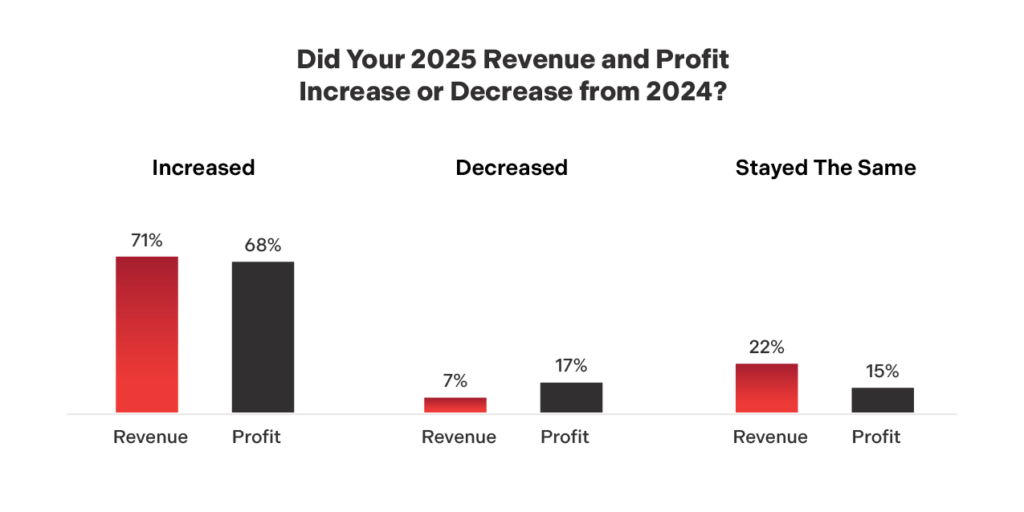
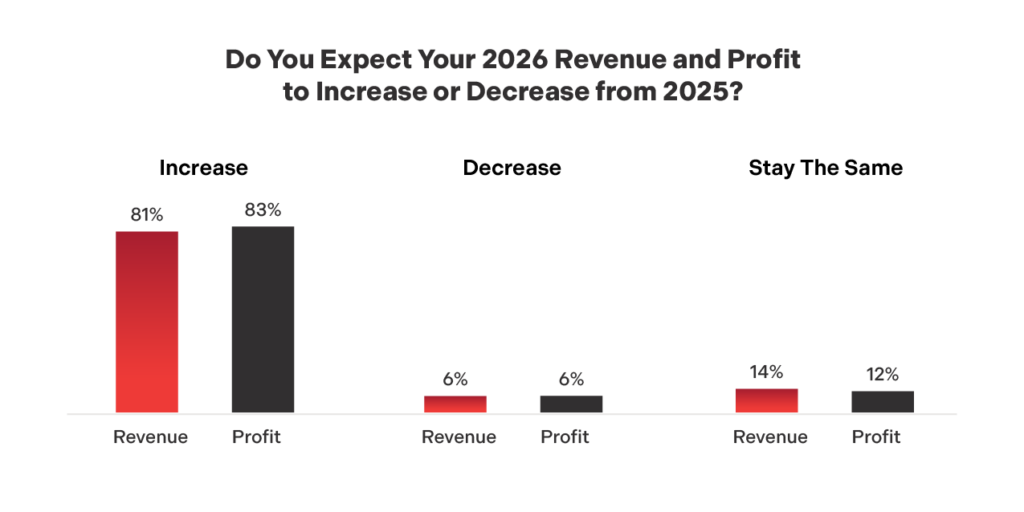
And despite the challenges of 2025, 71% of MSP survey respondents increased their revenue, and 81% expect revenue to increase in 2026 too. For 68% of MSPs, profit also increased in 2025, and 83% expect it to increase this year as well.
Jeremy Colwell, founder and managing director of The Human IT Company, an MSP in Vancouver, British Columbia, says both his top and bottom line grew in 2025 and he’s optimistic for 2026. One reason is he anticipates cybercriminals will try to take advantage of geopolitical turmoil, leading to more need for cybersecurity services. “But that said, generally speaking, everyone’s economy seems to be diversifying, and with that diversification comes opportunities for growth,” he adds. “On top of that, we’ve really doubled down on our niche and we’re seeing some of the benefits of that, which I believe will contribute to other growth opportunities through 2026.”

Tech Support Now, an MSP in Hurst, Texas, broke the million-dollar mark for the first time in 2025, and net profit went from negative in 2024 to 17%, according to Tom Burnett, president. “So, we’re real excited about this year,” he says. “We’ve got a broad range of clients and we’re starting to narrow our focus on the type of clients that we want and the industries that we feel we’re most proficient in.”
He’s not worried about the overall economy, as many of his clients are growing themselves, and cautiously gearing up for more growth in 2026.
For Barrett Earney, CEO of Earney IT, 2025 was the best year his Wilmington, North Carolina-based MSP has ever had. “It was our third year of consecutive 40%-plus growth,” he says. “We are targeting the same for 2026.”
At the same time, though, he notes that lingering uncertainties in the business climate are causing clients to exert some pricing pressure, making it more imperative to be nimble and competitive.
What Helped MSPs Overcome a Sluggish Start to 2025
Colwell, Earney, and Burnett all agree that 2025 did get off to a sluggish start.
“I think everybody was very cautious in the beginning,” Burnett says. “A lot of chatter was around tariffs, and how’s that going to affect our business and our costs? By the second half of the year, we saw the momentum pick up, especially around the Windows 10 transition. We had a lot of clients go ahead and spend the money to completely upgrade a lot of hardware.”

Canada, says Colwell, did not face the same economic uncertainty as the U.S., but customers are looking for more value—and did more “tire kicking” than buying at the start of 2025. “As the year moved on, we started to see a little bit more bite in people ready to make changes, and to a large degree, that came around to our benefit as a result of M&A activity,” he says. They gained customers from larger, rolled-up MSPs that no longer provided the personal touch they were used to. Colwell was happy to oblige.
Earney, too, is benefiting from private equity acquisitions in his market, both targeting prospects that may be disgruntled with their rolled-up MSP provider and poaching talent from the acquired MSPs. “I feel like it’s going to work in our favor,” he says.
What’s Actually Driving MSP Revenue and Profit Right Now
According to our survey respondents, the products, services, and solutions driving the most revenue growth last year were managed services (67%), cybersecurity (56%), Windows 10 End of Life migrations/upgrades (38%), and co-managed IT (32%). No surprise, then, that those same services were also among the top profit drivers in 2025.
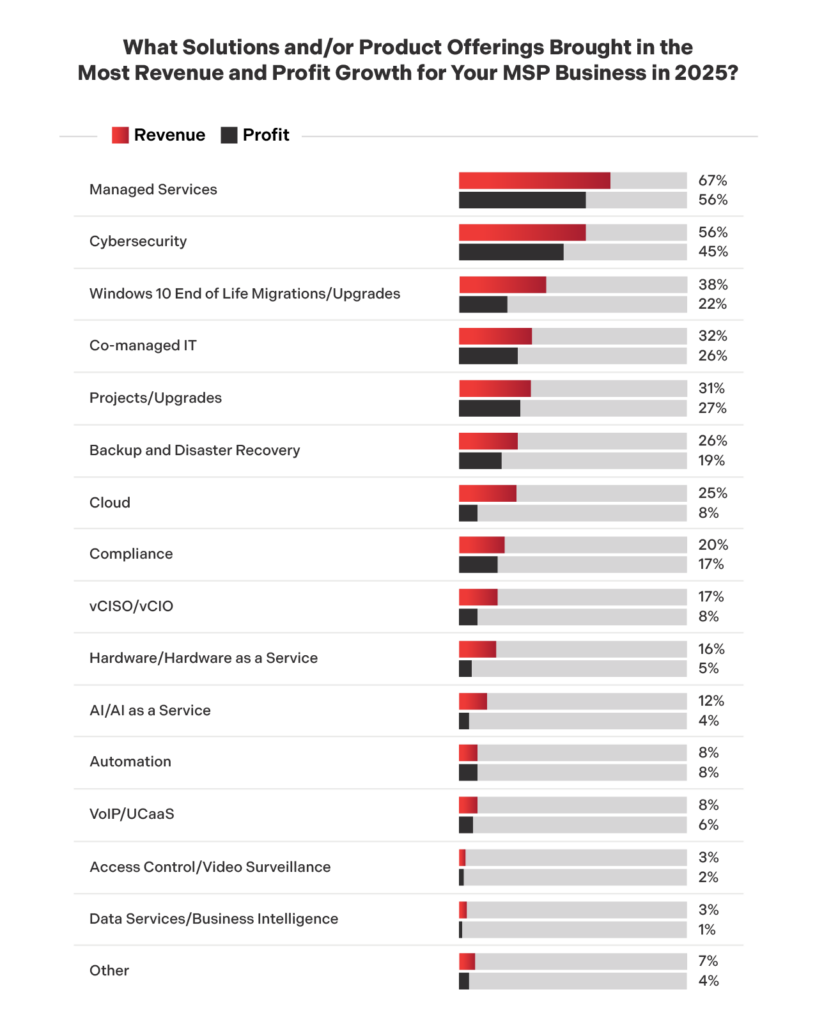
Looking ahead to this year, MSP survey respondents expect managed services (67%) and cybersecurity (49%) to remain the top revenue drivers, but they expect compliance (37%) and AI as a service (29%) to gain traction. MSPs also expect managed services (60%) and cybersecurity (47%) to remain the best margin getters, followed by compliance (36%), co-managed IT (28%), and projects/upgrades (21%).
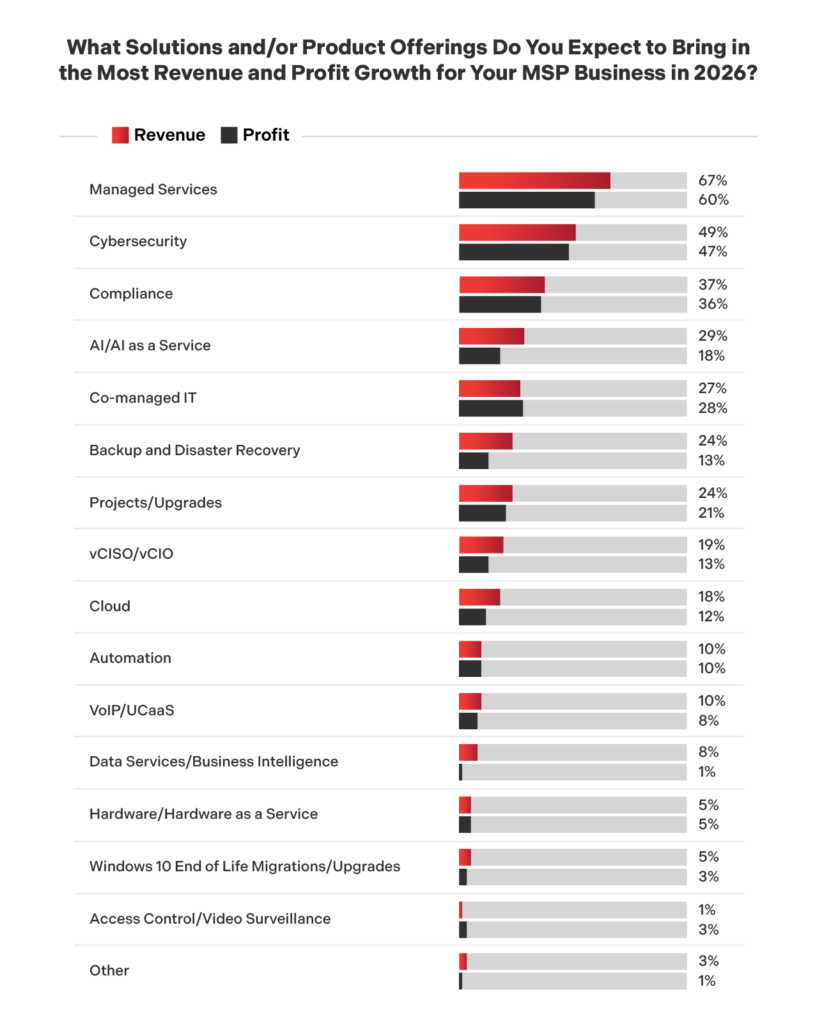
Burnett says he is focused on adding more managed services clients in 2026—his top profit driver—along with redesigning and ramping up their compliance offerings, which he calls labor-intensive but “incredibly profitable.”
Colwell says his MSP bundles cybersecurity with their managed services package, so together that was his top revenue driver, along with Windows 10 projects. While those projects are rapidly winding down, he anticipates in-demand project work for Office 2021 End of Life (October 2026) and Server 2016 End of Life (January 2027). “There’s still some room for a lot of those refresh projects to continue contributing strongly to the bottom line,” he says.
Like Colwell, Earney bundles cybersecurity with managed services, and those are his top revenue drivers. He says he’s also having success using VoIP as a “wedge” to gain new customers and move them into managed services. “It has worked extremely well and it’s profitable,” he says.
And while AI is driving change in the way MSPs work, monetizing AI as a service remains a challenge, Earney says. “But we’re looking at it. I know the potential exists; it’s not fully realized yet.”

Colwell anticipates potential for growth in the AI space around project-based AI consulting but says the path to a recurring revenue model is still unclear. “The Golden Goose is trying to find ways to take AI and turn it into monthly recurring revenue, and that’s proven to be a bit elusive for most people so far,” he says. “I don’t know that anybody’s managed it at scale yet.”
Burnett agrees. “For us as MSPs, it’s a tool. It’s not necessarily something that we can sell. We’re seeing a lot of independent guys pop up that are doing AI consulting for some of our clients … If anything, we may wind up looking at teaming up with some of these people to leverage their expertise if some of our clients start looking for that. But we’re not quite there yet.”
Growth Signals: New Customers, Headcount, and Momentum
Another sign of a healthy and growing MSP is the addition of net-new customers. Reflecting the uncertainty of 2025, 33% of MSPs said they gained fewer new customers than in 2024, with 35% gaining about the same as 2024. Another 25% said they gained slightly more customers than in 2024, and just 6% said they gained significantly more.
MSPs are much more optimistic for this year, however, with 46% expecting to gain slightly more customers than in 2025, and 37% expecting to gain significantly more.
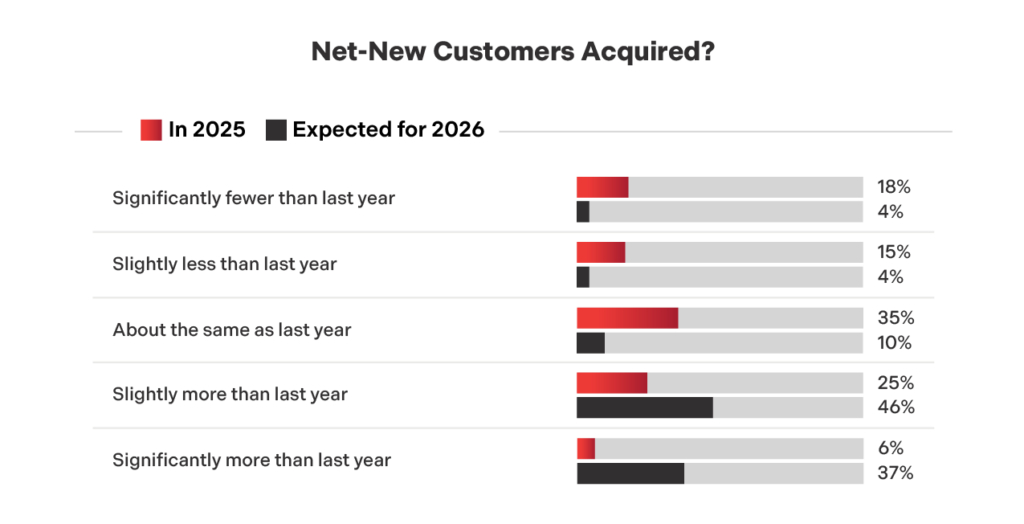
“We fell into the slightly more category in 2025 by doubling down on our niche and our positioning,” Colwell says. “It’s turned into a couple excellent new customers.” He says he’s expecting a small increase this year too.
Earney chalks up his MSP’s significant growth in net-new customers last year to the execution of marketing and referral campaigns and support from his TMT peer group, now part of Kaseya. He expects those results to continue.
For Burnett, net-new customer growth last year was down from 2024, but the customers they did gain fit into the “sweet spot” they are targeting (20-25 seats, with a mix of cybersecurity and compliance needs), and they plan to focus on that profile for 2026.
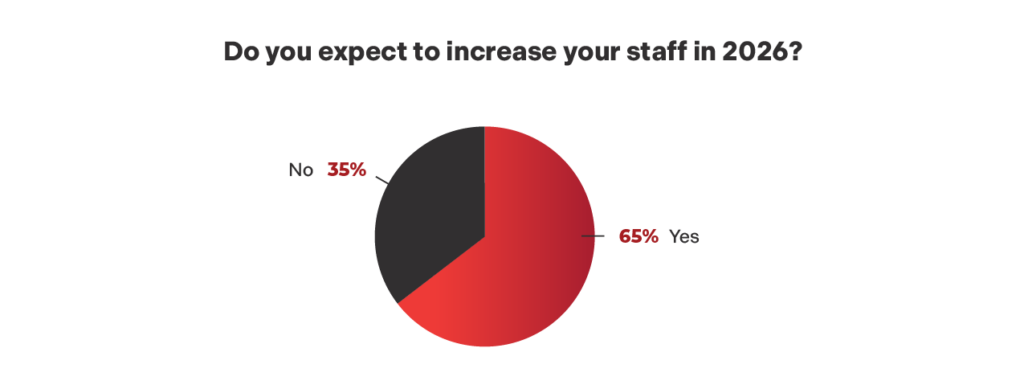
In general, it appears that MSPs are optimistic about hiring too, with 65% of MSPs planning to increase staff in 2026. Count Burnet in that group. He just hired a help desk manager and is planning to add a technician.
Earney, whose company just added 250 new endpoints in December, plans to add four new positions, potentially five, to support that growth. “It just depends on how much efficiency we can eek out of the help desk,” he says.
The Biggest Bets—and Biggest Worries—for 2026
Asked about the biggest opportunities for the year ahead, the responses ranged from AI and automation to compliance, co-managed IT, geographic expansion, gaining customers from struggling MSPs, Azure and cloud services, and acquiring another MSP.
Earney is eyeing an acquisition as well as making improvements in operational efficiency. “We’re really putting a lot of effort into our help desk and we’re doing a whole CX rewrite of everything—all the messaging, how the help desk responds, all of it.”
Colwell believes the biggest opportunity will be around generative engine optimization, or GEO (optimizing your content so it gets cited, summarized, or recommended by AI tools like ChatGPT, Copilot, Gemini, or Perplexity—not just ranked in Google search). “We’ve already seen that we’re getting phone calls based off GPT queries,” he notes.
Burnett feels like they have their marketing and operational efficiency plans in place, and says the biggest opportunity is simply execution. “I don’t see anything really holding us back other than ourselves,” he says.
On the flip side, MSPs say the challenges keeping them up at night include cyberthreats, staffing, competition from large MSPs, lead gen, how to monetize AI in an MRR model, new client acquisition, and margin pressure from low-priced competitors.
Earney agrees on that last headache—and finds himself competing against low-end MSPs claiming they can do everything he does at a third of the price. “It completely isn’t true. But now we have to prove our authority, prove our relationship, prove all the good things we’re doing,” he says. “I stress over that because I feel like we’re constantly being nipped at by these guys.”
For Colwell, geopolitical tension keeps him up at night, particularly as it has driven up RAM and hardware prices. “It is causing a lot of businesses to really slow down their hardware purchasing. I think that’s going to keep going for a while until some new capacity is brought online in the RAM manufacturing space; likewise chip manufacturing.”
Getting clients to spend on appropriate cybersecurity worries Burnett. “We’re seeing a level of sophistication in the attacks that’s changed, especially with the help of AI. People are not paying attention like they should.”
Why MSPs Are Entering 2026 with Confidence—Not Complacency
There’s no crystal ball, of course, and elements outside of an MSP’s control, like the economy, can foil the best laid plans. But based on our survey results, MSPs see opportunities and growth ahead for 2026.
Perhaps it’s because, like Colwell, Burnett, and Earney, they have spent considerable time honing their operations, their marketing and sales strategies, and their services portfolio.
Burnett, for one, recognizes that breaking the million-dollar mark is a first step; now he needs processes in place to scale. “I’m learning as a business owner that once you hit this number, things change operationally. We’re working quickly to make some changes so that we can continue this growth trend and properly service our clients.”
Earney says his positive results feel like the culmination of several years of work coming together. “It did feel like we were executing at all the right levels.”
If you missed the results from our last reader survey on client acquisition strategies, see Inside the Client Acquisition Playbook: MSPs Share Their Secrets