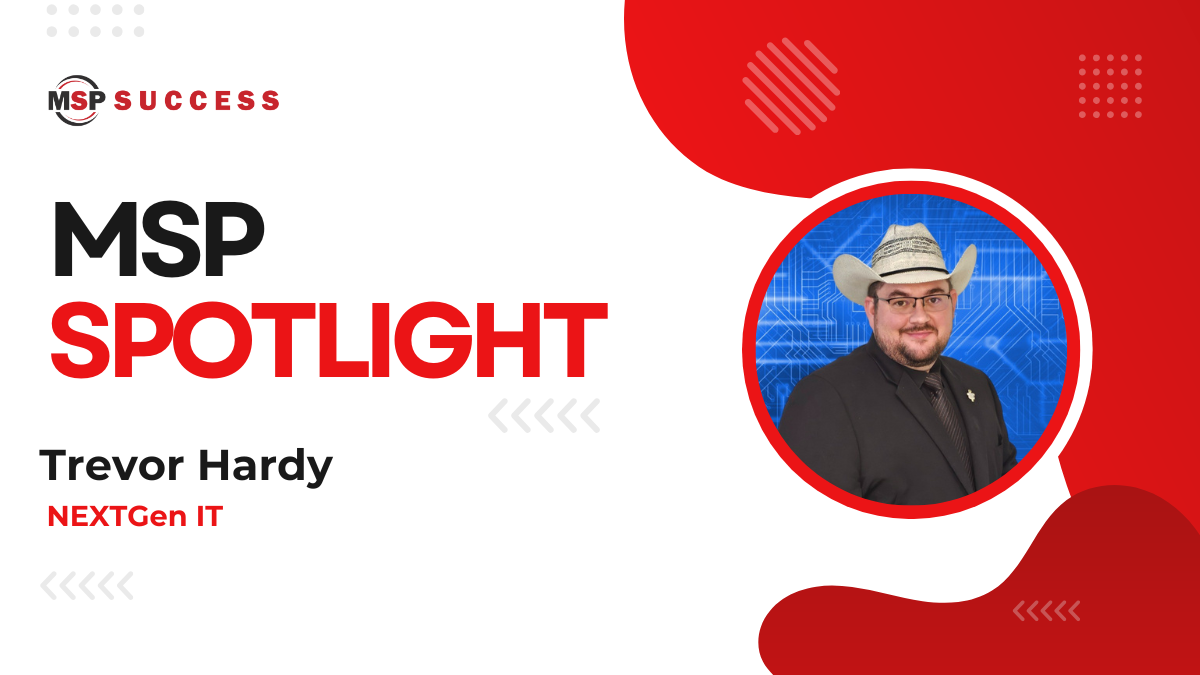
The rewards of being an MSP that goes “all out” for its clients are many, but for NEXTGen IT, sometimes it’s Aerosmith’s Steven Tyler singing Happy Birthday. Nestled in Muscle Shoals, Alabama, home of the famous “Muscle Shoals sound,” NEXTGen IT counts the FAME recording studios as one of its clients. When they needed a guitar amp soldered during a recording session, founder and CEO Trevor Hardy answered the call (not your usual IT service request, but a quick YouTube video equipped him for the job). It was the day before his birthday. The guitarist turned out to be Tyler, who sat down at the piano to serenade him. A week later Hardy got a thank you and an autographed picture from the rock legend.
Little wonder that type of customer service has helped propel NEXTGen IT to over $2 million in revenue since its founding in 2009 and rebrand in 2019. The four-person MSP has grown at a steady 20-30% over the past few years, despite being in an economically challenged geography and offering price breaks to some nonprofits that are near and dear to Hardy’s heart.
This past December, Hardy received Kaseya’s Community Involvement Award at the MSP Titans of the Industry Gala. Kaseya noted, “Beyond business success, the MSP’s dedication to service, including its charitable initiatives supporting children and veterans, demonstrates a level of community leadership that extends far beyond technology.”
In this interview with MSP Success, Hardy shares secrets to his success, how he recovered from an unexpected and devastating loss of MRR, and the guiding principles that steer his business.
MSP Success: What are your top 3 growth indicators you use to measure your MSP business, and why?
Trevor Hardy: I follow the money. I’m constantly looking at our MRR—what are we pulling in every month before I get out of bed? Then the number of clients we have and the number of seats we have to support per technician. We put those together and that tells me where we’re at. It lets me know if I need to be hiring, which is where I’m at right now. But at the end of the day, profit and net profit are going to be my final judgment, because I can’t hire somebody if I can’t afford to pay them. Of course, it’s also asking, are we seeing a lot of reactive tickets? Why? Is this something we can fix, or do we need to hire somebody? Those are our growth indicators.
MSP Success: Has there been a vendor, tool, or peer group that has been instrumental in getting you to where you are today?
Hardy: It definitely has been the TruMethods TruPeer peer group. I was already doing some work with Kaseya. They were instrumental in helping with a breach and attack that we had on one of our clients. They wanted me to give TruPeer a try, and they were willing to send me to Schnizzfest (an annual event for MSPs TruMethods used to hold) just to meet Gary Pica, founder of TruMethods. He gave me so much help before I even joined. Since joining, he’s put a framework in my hands that allows me to run my business. I’m not trying to reinvent the wheel. Building on that, now we can focus on marketing.
MSP Success: What were your biggest challenges this past year related to growth?
Hardy: In January of last year, we lost our largest client, our “whale.” It was nothing that we had done; it was bankruptcy. I lost nearly 50% of my revenue in a matter of seconds. I got that message, literally, as I’m standing on the stage at a TruPeer meeting, receiving the belts and the rings for our “pod” having the largest growth for the entire year. So that was an absolute high, followed by absolute destruction.
Not only did we lose the MRR that was under contract for another two years, but it also cost us the amount of equipment that we had in place. By the time I got home, the doors were locked and I couldn’t get my equipment. We took more than a $200,000 loss in equipment alone.
MSP Success: How did you recover from that loss?
Hardy: Gary Pica made it very easy for us to handle that loss. About three months prior to that, he had convinced me to double our prices. Our new seat cost was set to go into effect about a month after this hit. That was my saving grace.
When we adopted the full Kaseya 365 stack, I had made the decision to put a SOC on everything and have a single-seat cost across the board; we were no longer going to have a la carte items. I bought into the TruMethods way of doing things. We designed an opt-out letter that said we’re going to put all these packages in place for safety and cybersecurity, and here’s all the reasons why. If you don’t want it, you’ve got to fill out this opt-out form and send it back to us. But by doing so, you understand that if you get hit or attacked, you’re responsible. Only one customer ever called me on it and after I had a meeting with him, he approved it.
We kept nearly 50% of the business at twice the price we were at. We’ve since let some smaller clients go and we took on some larger ones with more seats.
During that same period of time, we decided to join TMT (now part of Kaseya) to take on some more marketing and sales coaching. Between Gary’s letter and the new marketing tools, it set us up to grow 100% in client size and revenue, with a 50% increase in net profit.
MSP Success: Who is the most impactful business leader or personal influencer whose techniques or leadership style you try to emulate, and why?
Hardy: We founded the business under three principles my grandfather taught me. First, he said, “I’ve taught you to follow the Golden Rule (treat others the way that you want to be treated). Take it one step further. Treat everybody the way you want to treat your grandmother.”
Second, he said, “A man is only as good as his word. If you shake a man’s hand or you tell a man you’re going to do something, come hell or high water, you do it. You’re going to make a mistake. What makes you a man will be how you own that.”
Third, quoting the late, great Paul “Bear” Bryant, he said, “If you believe in yourself, have dedication and pride, and never quit, you’ll be a winner. The price of victory is high. So will be the rewards. There’s going to be days you’re going to wish that you’d never started this company and there’s going to be days that you wished you’d given up and went back to work for somebody else. But there will be a day when you’re going to be happy that you did it.”
MSP Success: Is there a book you’ve read that has strongly influenced your leadership style or business operations that you can recommend to other MSPs?
Hardy: I want to highlight an MSP who wrote a book, Tim Taylor, that is amazing and I think anybody should read it. I’ve read it twice now. It’s How to Start and Run a Successful I.T. Company Without Losing Your Shirt. If you’re trying to start out, it’s a great book.
MSP Success: What is the top lesson you’ve had to learn that has been instrumental to your company’s growth?
Hardy: Not all money is good money. Just because there’s a dollar sign attached to it doesn’t mean you should be going after it. I learned that you’re not going to make every client happy, and not every client is going to be a good fit for you. The culture in your office is everything. Get a client that stresses your people to death, and you’ll find out very fast that they’ll ruin the culture. That’s the point of not all money is good money. Learning that you have to establish that culture, and it has to filter out to your clients and back in, is a big deal.
MSP Success: What advice would you give to other MSPs that are just starting out or struggling to grow their businesses?
Hardy: Find a peer community that can easily help you see from outside the box. That was instrumental for me. I was constantly dealing with the same issues over and over, and I couldn’t figure out how to fix them. Then I joined a peer community; they can see from a high level without the emotion involved. It’s the same thing as having a board of directors.